

Fall brings college application season, and for virtual school families it brings a second layer of questions. Who sends the transcript? Which teacher writes the recommendation when class happens on a screen? How do test dates and campus visits fit an online schedule? The answers are simpler than the worry suggests. This guide covers them, plus a timeline for juniors and what a senior should do this week.
A quick note on words: when this guide says "parent," it means whoever is raising your student, whether that is a parent, grandparent, aunt or uncle, foster parent, legal guardian, or another caregiver. The FAFSA uses the word more narrowly, and the FAQ below explains how.
At Stellar Oaks, seniors have a school counselor and a Success Specialist in their corner for every step below. Iowa also gives seniors something most states do not: a formula that tells you in October whether you will be admitted to the state's public universities. If senior year feels crowded, a weekly plan that holds essays and coursework is the place to start.
When Should a Virtual School Student Start College Applications?
Serious college prep starts in the spring of junior year, and most applications and essays get finished in the fall of senior year. The process is the same for a virtual school student as for anyone else. The one difference is lead time: your counselor and teachers handle transcripts and recommendations through the school's systems, so ask early, and ask in writing.
If You Are a Senior, Here Is What to Do This Week
Early Action and Early Decision deadlines at many colleges fall on Sunday, November 1, 2026, with a second wave on November 15. Do not count on a weekend grace period; treat November 1 as final unless the college's portal says otherwise. If any school on your list has an early deadline:
Confirm your recommenders have submitted. Check each letter's status in the Common App or the college's portal. If one is missing, send a polite reminder today.
Request your transcript now if you have not. Your counselor or registrar sends it. A request made today can land in time; one made Friday may not.
Finish the essay you have, not the one you wish you had. A clean, specific draft on time beats a perfect one late.
Submit by Thursday, October 29. Portals slow down and support desks close over the weekend. If coursework has slipped during application season, here is how to catch up without losing the week.
Iowa seniors: this is a good week to calculate your Regent Admission Index (below). A score of 245 or higher with the required courses means automatic admission to Iowa's three public universities, which turns one row of your tracker from "hoping" into "done."
No early deadlines? Use this week to lock your list and set your own Regular Decision deadline a week before the real one.
College Application Timeline for Virtual School Students
The college application timeline runs across four seasons, from research in the spring of junior year to a final decision by May 1 of senior year. Here is what belongs in each one.
Junior Year Spring
Research schools, sit the SAT or ACT if your target colleges use scores, and start a first list. Career exploration that shapes a college list belongs here too: a student who knows what they want to study writes a sharper list.
Summer Before Senior Year
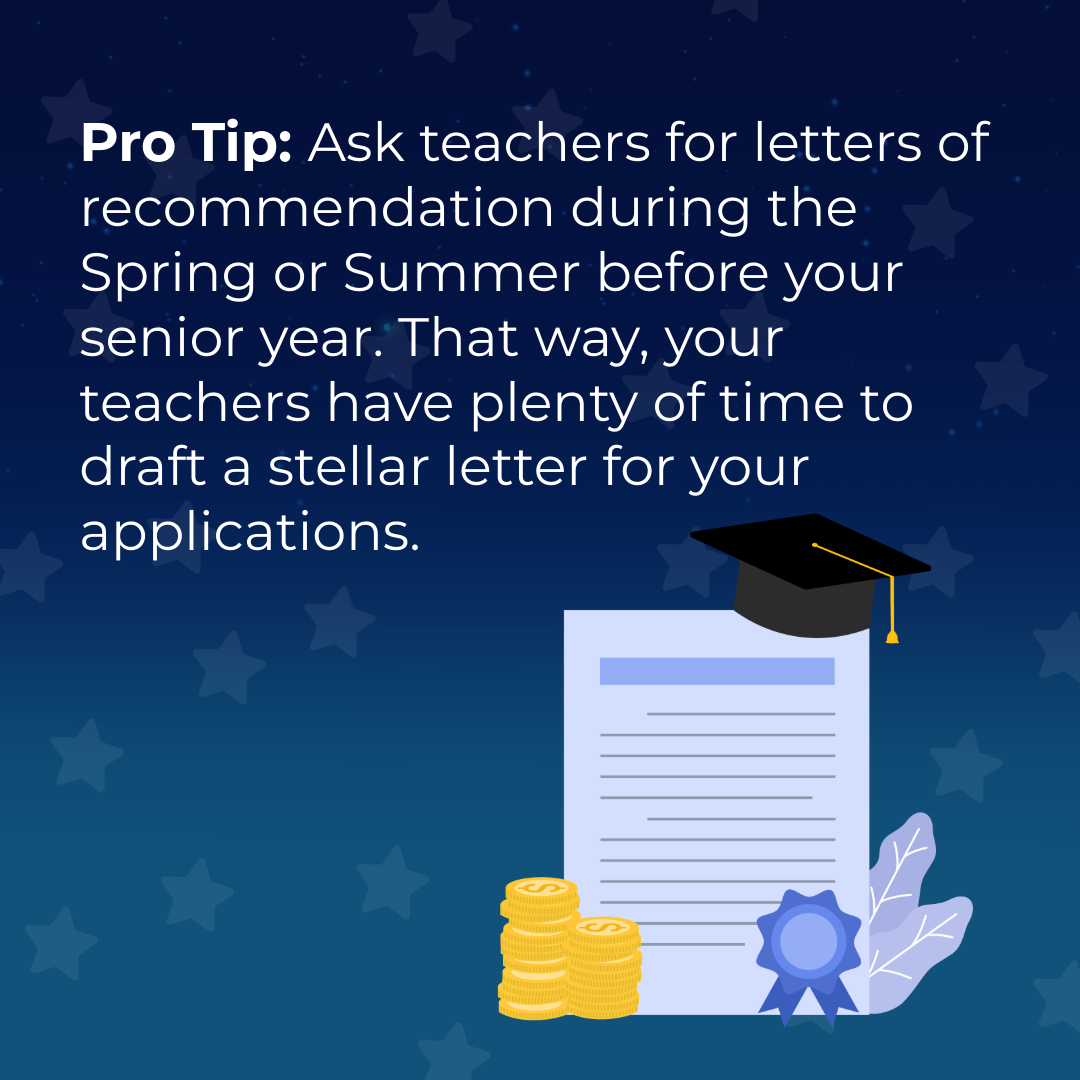
Draft the personal essay, narrow the list, and ask two teachers for recommendations before school starts. A summer ask gets a better letter than a September one.
Fall of Senior Year
Submit Early Action and Early Decision applications by November 1 or 15. File the FAFSA in October or November. The 2027-28 FAFSA is already open; it launched in late September this year, earlier than ever (Sinclair National Desk). Some state aid is first-come, first-served, and some states tie the FAFSA to graduation. A weekly plan that holds essays and coursework keeps senior-year grades steady while all of this happens.
Winter and Spring of Senior Year
Regular Decision applications are due January 1 through 15 at most colleges. Compare financial aid offers in the spring and decide by May 1, the National Candidates Reply Date that colleges honor as the earliest day they can require a commitment (NACAC).
Iowa Seniors: The Regent Admission Index and the Iowa Tuition Grant
Iowa's three public universities admit students automatically when they reach a Regent Admission Index (RAI) score of 245 and complete the required high school courses. The formula is public, so a Stellar Oaks senior can work it out this week (Iowa Board of Regents):
3 × ACT composite score (or a converted SAT or CLT score)
+ 30 × cumulative GPA
+ 5 × years of approved core courses
For example, a student with a 22 ACT, a 3.2 GPA, and 17 years of core courses scores 66 + 96 + 85 = 247, which clears the line. Students who apply without a test score are evaluated on GPA and core course completion instead (Iowa State University), and students below 245 can still be admitted through individual review.
The Iowa Tuition Grant helps Iowa residents attend eligible private Iowa colleges. There is no separate application: it runs entirely on the FAFSA, with a July 1, 2027 deadline for the 2027-28 year (Iowa Department of Education). The FAFSA is already open, so filing this fall puts a student in line early.
How a Virtual School Student Gets Transcripts, Counselor Letters, and Teacher Recommendations
A virtual school student's transcript, counselor letter, and recommendations come from the same people any student relies on: the counselor or registrar and the teachers who know their work. What changes is knowing who to ask and asking early. Here is how to reach your counselor and teachers.
The Transcript and School Report
Your counselor or registrar sends the official transcript through the Common App, a transcript service, or the college's portal. Students do not send it themselves. Request it in writing with your college list, and allow two weeks.
The Counselor Letter
Most applications ask for a counselor recommendation with the transcript. Help your counselor write a real letter instead of a form letter: send a short summary of your courses, activities, work, family responsibilities, and anything that explains a dip in grades.
Teacher Recommendations From Online Classes
Ask teachers who know your work, not just your grade: one whose live sessions you attended, whose feedback you answered, or who saw you improve. Give them a one-page brag sheet (projects you are proud of, what the class taught you, where you are applying) and at least four weeks' notice. Teachers who know a student through written work often write unusually specific letters, because they have a record of the student's thinking.
The School Profile
Colleges read a transcript alongside a school profile: a one-page document covering the school's model, accreditation, grading scale, and courses. Ask your counselor whether one is on file for this cycle and whether it explains how online courses and live sessions work.
How Flexible Scheduling Fits Campus Visits and Test Dates
Flexible scheduling lets a virtual school student visit a campus on a Tuesday without missing a lecture, because the lesson is still there that evening. Two habits keep that advantage real:
Plan the visit around the coursework, not instead of it. Virtual school attendance is usually measured by engagement and completed work, so a visit day still needs its lessons logged. A daily schedule with room for a test date makes this routine.
Register for the SAT or ACT early. Virtual school students test at a nearby test center on national dates, and fall seats fill. The next national dates are the December 5 SAT (register by November 20) and the December 12 ACT (register by November 6) (College Board; The Princeton Review). Request accommodations well ahead.
Virtual campus tours can trim the list before you drive anywhere.
How Many Colleges Should Your Student Apply To?
There is no correct number, but most students land between six and nine applications. Common App reports that applicants submitted an average of 7.06 applications each in 2025-26, up 49 percent since 2016-17 (Common App). More applications widen options, and they also multiply essays, fees, and deadlines. A balanced list:
2 to 3 reach schools: competitive, but plausible
3 to 4 match schools: where your student's profile fits admitted students
1 to 2 likely schools: admission is probable and the fit feels right
How to Write the College Essay Without a Family Battle
The strongest college essays are specific, personal, and written in the student's own voice, so the best role for a parent or guardian is asking good questions, not editing sentences.
Start with conversation, not a draft. Talk through moments, challenges, and values first.
Protect the student's voice. Readers want to hear a 17-year-old, not a polished adult.
Draft early, revise in rounds. A summer draft leaves room for feedback without panic.
Limit readers to two. A teacher or counselor, and one parent or guardian.
Sample College Application Tracker
A shared application tracker, on a spreadsheet or a wall calendar, keeps every deadline and document in one place where everyone can see it. Here is what a few rows might look like:
| School | Deadline and plan | Materials status |
|---|---|---|
| State university | Nov 1, Early Action | Transcript sent; two letters in; essay final |
| Private college | Nov 15, Early Action | Transcript sent; one letter pending; supplement drafting |
| Community college | Rolling; file by Feb 1 | Application open; FAFSA filed Oct 20 |
Set personal deadlines a week ahead of the real ones, and give recommendation letters and state aid steps their own rows.
For Parents and Guardians: Your Role as Learning Coach During Application Season
During application season, the Learning Coach's job is logistics and steadiness, not authorship, whether that coach is a parent, grandparent, guardian, or another caregiver. Here is more on the Learning Coach's role.
Keep the tracker current, and book test dates and visits.
Watch for real overwhelm. A student avoiding the portal is usually stuck on one item; find the item.
Celebrate submissions, not just decisions.
Remember senior grades still count. Colleges request final transcripts in June.
Frequently Asked Questions
What is the difference between Early Decision, Early Action, and Regular Decision?
Early Decision is binding: an admitted student commits to attend. Early Action is non-binding, with an early deadline and an early answer. Regular Decision has later deadlines and no commitment. Early deadlines mostly fall on November 1 or 15, and Regular deadlines in early January.
How does the Regent Admission Index work for an Iowa online school student?
Exactly as it does for any Iowa student. The RAI adds 3 times the ACT composite, 30 times GPA, and 5 times the years of approved core courses. A score of 245 or higher, with the required courses, means automatic admission to Iowa, Iowa State, and Northern Iowa. Ask your counselor how your transcript reports core-course years.
We are guardians, not parents. Who counts as the parent on the FAFSA?
On the FAFSA, a parent means a biological or adoptive parent, so a legal guardian is not reported as one (uAspire). A student with a court-appointed legal guardian, either when they turned 18 or now, is generally treated as independent and may be asked for the court order (Millersville University). Grandparents and other relatives raising a student without adoption or guardianship have a different path, so ask your counselor or the college's financial aid office before filing.
How does a virtual school student send transcripts to colleges?
The counselor or registrar sends the transcript through the Common App, a transcript service, or the college's portal. Request it in writing with your college list, and allow at least two weeks.
Do we need a private college counselor?
Not usually. Your school counselor, each college's admissions office, and free resources cover most families. A private counselor can help in a complex case, but one is not required for a strong application.
Can a virtual school student take the SAT or ACT?
Yes. Register through collegeboard.org or act.org for a national test date at a nearby test center, like any student. Register early, since seats fill, and request accommodations before the deadline.
Application Season in Virtual School: One Deadline at a Time
College applications feel like the biggest test of high school, and they get done the way every big task does: one transcript request, one essay draft, one submission at a time. At Stellar Oaks, your counselor, your Success Specialist, and your Learning Coach are all part of that plan. Strong roots grow the same way: a little at a time, long before the branches show. The habits from starting strong in virtual school carry right into this season, too.
Curious how Stellar Oaks supports career exploration at every grade level? Browse our FAQs.
Follow us for more support and tips all year: Facebook | Instagram
Questions? Our enrollment specialists are here to help.

Sources
Common App, End-of-Season Report 2025-26 (August 20, 2026). commonapp.org
Sinclair National Desk, Education Department Opens 2027-28 FAFSA Early, Marking Program's Earliest Launch (September 24, 2026). okcfox.com
College Board, SAT Dates and Deadlines. collegeboard.org
The Princeton Review, ACT Test Dates. princetonreview.com
National Association for College Admission Counseling, Guide to Ethical Practice in College Admission (National Candidates Reply Date). schoolcounselor.org
uAspire, Which Parent Is a Contributor on the FAFSA? uaspire.org
Millersville University, Legal Guardianship (FAFSA dependency question). millersville.edu
Iowa Board of Regents, Regent Admission Index. iowaregents.edu
Iowa State University, First-Year Students: Admission Requirements. iastate.edu
Iowa Department of Education, Iowa Tuition Grant. educate.iowa.gov
