
How to Structure Your Iowa Virtual School Schedule

One of the quiet advantages of virtual school is flexibility. The catch is that flexibility only helps when it is used deliberately. A day with no shape is just as hard to get through as a day that is packed end to end, and it usually leaves less finished.
Stellar Oaks Virtual Academy runs on an asynchronous model with optional live lessons, which puts the shape of the day genuinely in your family's hands. Here is how to build one that works with your student's energy instead of against it.
What Time of Day Should My Student Study?
The best time to study depends on the task and on the student, not on a rule. Research does describe some general windows, though, and knowing them makes it far easier to put the right work in the right place.
Research summarized byLSBF outlines a few phases most people move through:
Late morning, roughly 10 a.m. to 2 p.m.: Concentration and retention are strongest. Good for new concepts and problem sets.
Afternoon, roughly 2 p.m. to 5 p.m.: Analytical and critical thinking peak, which suits assignments, revisions, and projects.
Evening: Quieter, with better memory consolidation. Useful for review, less useful for learning something for the first time.
Build around the student you have. A student who is sharp early should hit their hardest subject first thing. A student who does not really engage until after lunch should have their toughest coursework there instead of fighting the clock every morning.
Organize Coursework by Size and Type
Not every assignment deserves the same block of time or the same mental energy. A few minutes of sorting on Sunday saves a lot of scrambling on Thursday.
Big assignments, meaning essays, projects, and test prep, need a dedicated block during your student's strongest window.
Small assignments, like a worksheet or a short reading response, slot into the shorter gaps between larger tasks.
Due-date tracking matters more in virtual school than it did in a classroom, where a teacher handing back a paper served as the reminder. A visible, updated list of what is due does that job now.
This helps every student and it is close to essential for some. Students with ADHD often do far better with a big, vague task cut into small concrete steps than with a single undefined block labeled "schoolwork."

Don't Skip the Offline Breaks
It is tempting to think a shorter school day means students can push straight through. The opposite is closer to true. Screen-based learning asks a lot of sustained attention, and breaks are not time subtracted from learning. They are how attention gets rebuilt.
Northwestern Medicine notes that a healthy routine does not need to be complicated. It needs a few consistent anchors, especially regular movement and quality sleep. Translated into a school day:
A short walk or a stretch between subjects
Morning sunlight shortly after waking, which helps set energy and focus later in the day
A consistent evening wind-down signal, which matters most before a test day
Iowa's calendar puts real pressure on this in two places. The fall stretch, when many families are busiest with harvest, fair season, and activities, is when routines get abandoned first. And from December through February, early sunsets and cold mean a student who has not been outside by early afternoon likely will not go at all. Both are manageable if you plan for them rather than react to them: put outdoor movement in the first part of the day, keep an indoor reset ready for the days that will not allow anything else, and expect to rebuild the routine at least once between September and March. That is normal, not failure.
Even a five-minute break has measurable value. A few deep breaths, a quick stretch, or naming a couple of things that went well can lower stress enough to make the next block easier to start.

Build a Sample Schedule
Every family's day looks different, but a template gives you something to adapt:
Morning: Wake, get light and movement, breakfast
Mid-morning: Hardest subject or an optional live lesson
Late morning: Second focused independent work block
Midday: A real lunch break away from the screen
Early afternoon: Coursework and assignments in the second-best energy window
Late afternoon: Smaller tasks, review, or a movement break
Evening: Light review only if needed, then a consistent bedtime routine
For families whose evenings fill up with chores, practices, or 4-H, it is usually better to shift the whole school day earlier than to try to squeeze coursework in after dinner. Front-loading works far better than backfilling.
Sample Schedules by Age Group
A kindergartner and a high school junior need very different structures. The principles carry across. Block length and independence are what shift.
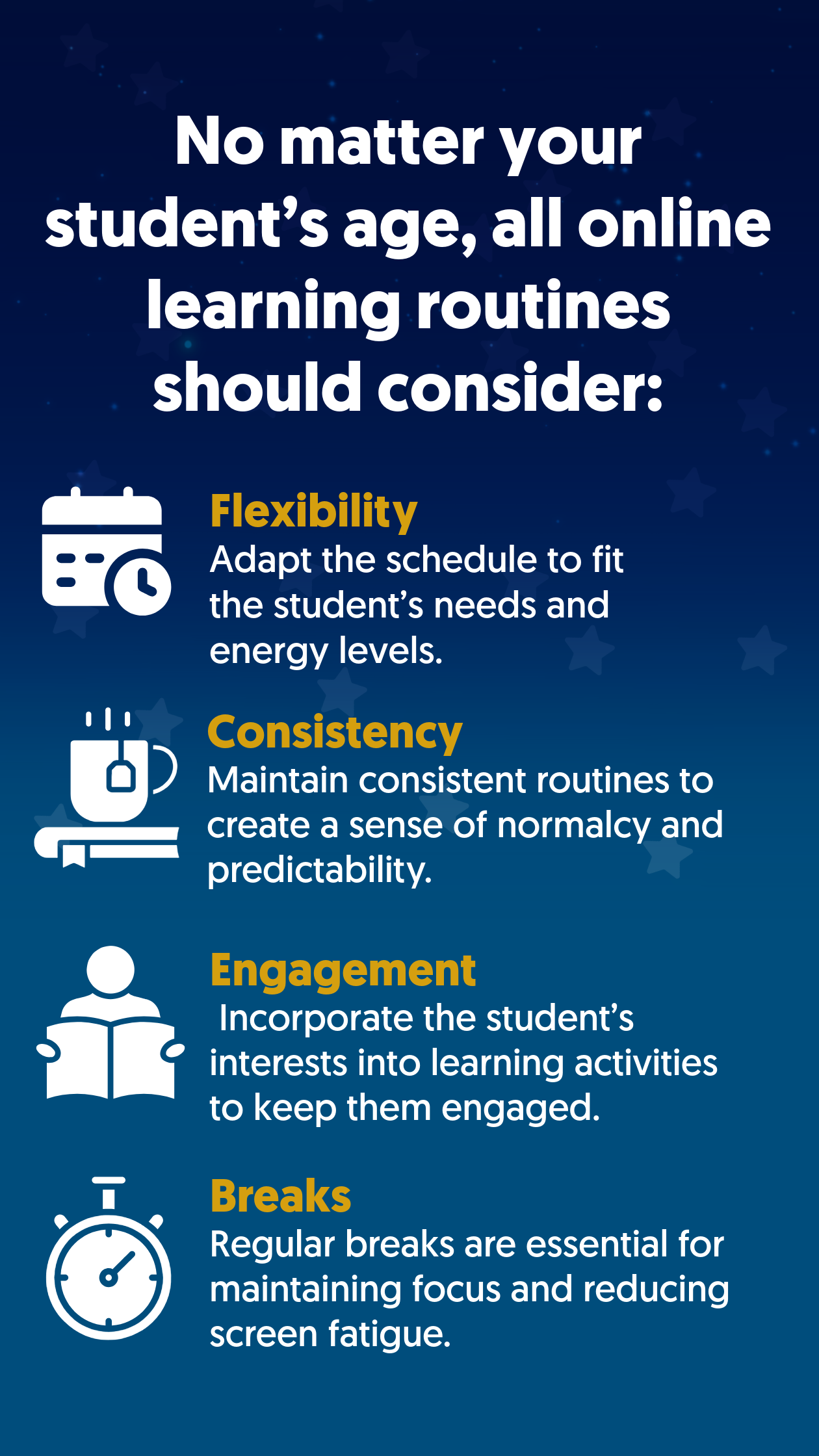
Elementary school:
Work blocks of 20 to 30 minutes with movement in between
Live lessons clustered earlier in the day, when focus is most available
Hands-on and offline activities woven between screen-based lessons
A visual, picture-based schedule instead of a written list
Middle school:
Blocks of 30 to 45 minutes, still broken up regularly
A mix of live lessons and independent work with clear start and stop times
Growing independence in managing their own checklist, with a Learning Coach check-in once or twice a day
Extracurriculars and social time scheduled on purpose rather than treated as leftovers
High school:
Blocks of 45 to 60 minutes aligned to natural energy windows
Real ownership of the schedule by the student, with the Learning Coach moving into a lighter check-in role
Protected time for test prep, projects, and career or college planning
Protected sleep, which high schoolers cut first under pressure and which costs them the most
The through line at every age is the same: put hard work where the energy is, and do not let breaks become the first casualty of a busy week.
What This Looks Like at Stellar Oaks
The asynchronous model is what makes all of this possible. Coursework is there when your student is ready for it, which means the schedule can bend around a family's actual week.
A few pieces worth putting on the calendar deliberately:
Optional live lessons are your fixed anchors. Schedule them first, then build independent work around them.
One-on-one sessions and tutoring work best booked ahead of a problem rather than in response to one. A standing slot in the hardest subject is a good default.
Your Success Specialist stays with your family from enrollment through graduation and is the right person to call when the schedule keeps falling apart for reasons you cannot name.
My Stellar Support holds login help, orientation walkthroughs, and progress tracking. Bookmark it in week one.
This is the practical version of School of One. The daily schedule is one of the clearest places you can see a plan built around the student rather than the other way around.
Frequently Asked Questions
What if my student's best focus time doesn't match the live lesson schedule?
Live lessons are usually fixed, independent work is not. Anchor the day to live sessions, then place the hardest independent work in your student's real energy window.
How long should a break actually be?
Five minutes is enough to be worth taking. Between major work blocks, 15 to 20 minutes works better, especially around the midday slump.
Should weekends follow the same structure?
Not exactly, but keeping wake and sleep times reasonably consistent across the weekend makes Monday morning much easier.
Our fall is genuinely busy. Can the schedule shift seasonally?
Yes, and it probably should. Many families run an earlier, tighter day through the busiest weeks and a more spread-out one afterward. Deciding that on purpose works far better than letting the schedule erode week by week.
When the Schedule Falls Apart (Because It Will)
Something always goes sideways. An appointment, a rough night, a storm that takes out the internet mid-lesson. A good schedule bends without breaking entirely. Build that in from the start:
Leave one buffer block per day. An unscheduled 30 to 45 minutes absorbs the unexpected without pushing everything else back.
Keep a "minimum viable day" ready. On genuinely hard days, know the two or three things that must happen and let the rest move.
Do not try to make up a lost day all at once. Spreading missed work over a few days is more sustainable than cramming it into one already-full one.
Revisit the schedule every couple of weeks. What worked in September rarely fits January without adjustment.
Treating the schedule as a living document rather than a rigid contract keeps it useful instead of turning it into one more thing to feel behind on.
Tools Worth Trying
A visible wall calendar or whiteboard, especially for younger students who benefit from seeing the whole week at a glance
A shared digital calendar for older students juggling live lessons, activities, and independent deadlines
A kitchen or phone timer to mark the start and end of focus blocks without constant clock-checking
A two-minute end-of-day review on what worked and what did not, which is how a schedule improves over the year instead of staying static
Consistency Beats Perfection
The biggest predictor of a schedule sticking is not how well designed it is on paper. It is whether it is realistic enough to repeat, day after day, without a fight. Give a new structure two full weeks before deciding to change it. Most schedules need a round of tweaking once real life gets involved.
A day built with intention, one that respects your student's energy, sizes work correctly, and protects real breaks, sets the tone for a calmer and more sustainable year.
Ready to build a school day that actually works for your family? Enroll Today
Questions? Our enrollment specialists are happy to help: Call Today!
Follow along for scheduling tips all year: Facebook | Instagram | TikTok

Sources
LSBF, What Is the Best Time for Studying — Day or Night? lsbf.edu.sg
Northwestern Medicine, Healthy Habits to Strengthen Your Daily Routine. nm.org
ASU Prep Digital, Online Learning Routine. asuprepdigital.org
